JDCMBMarinAlsop

  • Subscribe to our RSS feed.
  • Twitter
  • StumbleUpon
  • Reddit
  • Facebook
  • Digg

Friday, February 17, 2012

Friday Historical: Szymanowski plays Szymanowski

Posted on 1:09 AM by Unknown
Tomorrow evening I am doing a pre-concert talk about Szymanowski at Symphony Hall, Birmingham, where the doughty CBSO, Ed Gardner and friends are performing the elusive Polish composer's Stabat Mater (more info on their site here). The talk will be along the lines of "Introducing Karol" - though I'm a tad aware that people in Birmingham are probably among the UK's most Szymanowski-aware, following Simon Rattle's championship of him and the magnificent recordings that resulted in the 1990s.

Do come along and say hi if you're in the area. Meanwhile, here is a Friday Historical of Szymanowski playing one of his own Mazurkas.

Read More
Posted in CBSO, Edward Gardner, Karol Szymanowski, Symphony Hall Birmingham | No comments

Thursday, February 16, 2012

Jonas Kaufmann, wrapped in Viennese gold

Posted on 2:08 AM by Unknown

If you were wondering where I'd got to... Been here, hearing this. Above: Jonas Kaufmann and Helmut Deutsch take a curtain call in the Vienna Musikverein after what I think was the third of five encores.

Song recitals in the golden hall are not plentiful - mostly they are given in the smaller Brahmsaal - and this was Kaufmann's first "Liederabend" therein, following a highly successful run as Faust at the Staatsoper. It was a programme of Liszt, Mahler, Duparc and Strauss, which he and Deutsch introduced in Munich last summer (schedule here - Berlin tomorrow, Paris on Monday; London Wigmore Hall not until June, though). And if you think Vienna is not a place that can go nuts, think again. By the time the encores had rounded off with Strauss's 'Zueignung' and a rendering of 'Dein ist mein ganzes Herz' that could have turned even Tauber green with envy, your blogger and her companion were sobbing for joy along with the rest of the city.

Here is the full programme. And here is a video on Kaufmann's website introducing it. 


I won't keep you sitting here reading this blogpost all day, but a few highlights follow. First of all, Deutsch needs a credit all his own: the glowing, streamlined sounds that emerged from that piano would have wrapped Kaufmann's voice in pure gold even if the hall had not already done so. Deutsch has been Kaufmann's mentor in many ways and their partnership remains exceptional: they shine not merely as singer and accompanist individually, but as a duo even greater than the already phenomenal sum of their parts.


The Liszt's high spots included hushed raptness in 'Glocken von Marling', an engagingly narrative 'Drei Zigeuner' and an emotional roller-coaster of 'Freudvoll und Leidvoll'. Kaufmann's dark-hued tone is ideally suited to the Mahler Rückertlieder, and his ability to capture haunted, mystical atmospheres drew 'Am Mitternacht' towards undreamed-of inward realms. 


If any moment of the recital was any less convincing, it was the Duparc: a French group, even such a heady and sensual one, seemed to sit comparatively oddly against the rest of the programme, something brought into focus when Kaufmann launched into his home heartland with the Strauss Lieder immediately afterwards. Duparc is more Wagnerian than Faure or Debussy, yet it could be that these exceptional, kaleidoscopic songs, which feel like musical incarnations of Odilon Redon's late pastels, still need to settle to reach the same level of assumption that Kaufmann has achieved in Strauss. It was the Strauss that stayed with us: laughter for 'Schlechtes Wetter' (it was snowy, well below freezing and very windy out, and we'd have liked to sample whatever cake Kaufmann and Deutsch decided to bake); tears for a 'Befreit' almost too pain-filled to listen to (many pairs of spectacles were removed around us in the hall). 


Dein war unser ganzes Herz.. It's not the first time I've felt that Kaufmann is an artist who thrives on encores. This was when he seemed to relax the most and, frankly, let rip. Like most excellent artists, he seems fed by the audience's energy, which is as it should be. There's something about the creation of atmosphere in a performance that has less to do with the individual technical details than with the relationship between the performers, the degree they can communicate their mastery and passion for music to the audience, and much to do with... well, if anyone could articulate exactly what that "X factor" is, we wouldn't need daft TV programmes named after it.


It's when artists start to fly and take us up to 33,000 feet with them. It's when you can't believe the beauty in your own ears, and you can't hold onto it, either, but you're trying to in any case, and you know you are hearing something you'll never forget for the rest of your life. And you know it when you hear it, and you don't hear it very often. Perhaps 19th century commentators could have recognised its necessity by their very nature and expressed it in terms of touching something divine, which is what "high art" aspired to do. Such terminology is somewhat frowned on today. In a world that's terrified of "elitism", anything that sounds too good will be bashed. But when you get down to it, that is what's happening and that is what great artistry is all about, and that is what all the other very good but less "great" artists wish to do, and that is why we become musicians, because music can do this and that's why it exists. And when it reaches that rare level, you feel lucky to be alive to hear it. It's real. It's true. So just get over it, accept it and open your ears. 


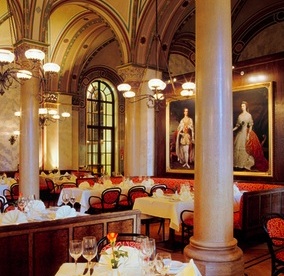
And as if this wasn't enough...the day after, we attended Mitsuko Uchida playing the last three Schubert sonatas - Schubert in Vienna in the snow, with the B flat Sonata a crowning, aching, lonely wonder. Add to this a visual feast at the recently renovated Albertina gallery - two floors of an Impressionist exhibition (yes, with plenty of Redon pastels), one floor of the permanent collection and a top floor of a huge, jaw-dropping and revelatory exploration of Magritte. To say nothing of lunch at the Cafe Central, a romanesque-arched temple to kaffee und kuche once frequented by Trotsky, Freud and many, many more. We had their berry strudel, packed with kilos of purple fruit, and their trademark cake: chocolate, orange and marzipan with the lightest texture and finest flavours...


...look, as the Beatles would say, it's been a long, cold, lonely winter, so please forgive a few of the superlatives above. Right now, I think we deserved to enjoy them a little. All together now: "Wien, Wien, ach, du allein..."


Read More
Posted in Jonas Kaufmann, Mitsuko Uchida, Musikverein, Vienna | No comments

Friday, February 10, 2012

In search of the spirit of Hoffmann

Posted on 12:32 AM by Unknown
It's a fantasy world here in London this morning. Everything has turned white. A suitable setting for a fabulously fantastical evening courtesy of Offenbach, ENO, director Richard Jones and a cast headed by the doughty Barry Banks as ETA Hoffmann. But why do so many of the musical creations based on this seminal German Romantic author have so little to do with what he actually wrote? Is he just...too damn scary? I have a piece about this in today's Independent. But below, please find the director's cut, in which Schumann comes to the fore rather more than Offenbach.


First, here's the trailer for tonight - it's a co-production with the Bavarian State Opera. I just hope the transport system holds up under our massive and alarming 2cm of snow.


Where would we be without the stories and novels of ETA Hoffmann? The German author’s dazzling imagination underpins some of the world’s most popular and enduring operas, ballets, and even piano music. Yet there’s a real disconnect between Hoffmann’s influence and the adaptations we see on stage. Few of them bear much resemblance to his originals. Indeed, the writer’s absence from his own legacy is so striking that Richard Jones, the director of English National Opera’s new production of The Tales of Hoffmann, has apparently recommended to his lead tenor, Barry Banks, that he need not read the tales by Hoffmann on which the opera is based.

That could seem surprising – after all, the hero of Jacques Offenbach’s opera is loosely modelled on the real Hoffmann. But perhaps it is a practical matter: so vivid and terrifying are these seminal works of German Romanticism that our star singer would risk having nightmares for weeks.

The opera – about to open at the Coliseum in a co-production with the Bavarian State Opera, Munich – features Hoffmann as a dissolute, drunken poet looking back over his thwarted love affairs and finally finding redemption in his art alone. Three stories are involved, each concerning one of three women, Olympia, Antonia and Giulietta, each with an ‘evil genius’ figure who puts Hoffmann through a series of supernatural tribulations. Olympia is an automaton, made to appear real when Hoffmann dons magic spectacles. Antonia dies in his arms after her mother’s ghost persuades her to sing, against medical advice. Giulietta, a Venetian courtesan, steals his reflection, and implicitly his soul. Every tale is based on a Hoffmann original. Yet Hoffmann’s actual writing is so disturbing that the operatic version, despite its gripping narrative and unforgettable music, can barely scratch the surface.

We seem little concerned with the real ETA Hoffmann today, beyond specialised academic studies, but his significance was multifarious and profound. His life – contemporaneous with Beethoven – was short, difficult and tragic. Born Ernst Theodor Wilhelm Hoffmann in Königsberg in 1776, he adored music obsessively, to the point that he changed his ‘Wilhelm’ to ‘Amadeus’ in tribute to Mozart. His family background appears to have been unstable, rife with mental problems; perhaps his imagination was predisposed to become fevered. He lived a turbulent existence, moving between Germany and Poland, working variously as a clerk, a jurist and a music critic, writing and composing prolifically the while. He became “dissolute” and syphilis killed him when he was only 46. The writer George Sand said of him: “Never in the history of the human spirit has anyone entered more freely and more purely into the world of dream.”

So why do the popular adaptations of his works veer so far from the originals? The Nutcracker, that ubiquitous Christmas ballet, is a case in point. It presents a supremely simplified version of a tale in which the “world of dream” is deeply entangled with that of reality. For balletic purposes, the most potent and horrific elements of Hoffmann’s Nutcracker and Mouse King are stripped away; in their place the audience sees infinite sugar. Hoffmann himself had dreamed up, among other things, a seven-headed mouse king that sets gruesome traps for its own offspring. Not so great for family viewing, perhaps.

Then there’s Coppelia, second only to The Nutcracker in popularity: a sweet, frothy story about a youth who becomes infatuated with a doll, inducing his girlfriend to take good-natured revenge. Set to irresistible music by Léo Delibes, it is based on the same Hoffmann tale as the Olympia episode in Offenbach’s opera. Yet the original story – The Sandman – couldn’t be less sweet and frothy if it tried. It involves murder, madness, blinding and the manufacture of eyes, as well as the recognition of the darkest and most destructive side of the human psyche, all of it conjured with imagery so potent that it impacts upon our subconscious at an almost primal level. It can be no coincidence that Sigmund Freud made considerable reference to this story in his essay The Uncanny, describing Hoffmann as “the unrivalled master of the uncanny in literature”. Incidentally, Freud associated the terror of losing sight with the fear of castration.

The composer most faithful to the underlying spirit of ETA Hoffmann was Schumann, who did not use the actual stories at all – though this arch-romantic’s tragic life, with its descent into syphilitic madness, reads almost like one in itself. He frequently took inspiration from the author: Fantasiestücke, Nachtstücke and Kreisleriana are all titles used by both creators. The turbulent, mercurial atmosphere of Schumann’s piano cycle Kreisleriana catches the tone of Hoffmann to perfection, although there is no programmatic link.


Hoffmann had given the name ‘Johannes Kreisler’ to a sort of alter-ego that finally became a character in his last novel Lebensansichten des KatersMurr (The Life and Opinions of the Tomcat Murr) – in which the autobiography of a savvy feline is accidentally mingled with that of a temperamental and introverted musician. The young Johannes Brahms, another passionate Hoffmann aficionado, sometimes signed himself ‘Joh. Kreisler Jun.’ (Johannes Kreisler Junior), including on his official Op.1, the Piano Sonata in C major.

Offenbach’s choice of Hoffmann as the basis for his last opera was a less personal matter, but no less telling. Towards the end of his life, though celebrated for his riotous and risqué Parisian operettas, he yearned for recognition as a serious composer. These stories provided the ideal medium. Perhaps, too, he was able to identify with a different aspect of the anguished hero; as a German Jewish immigrant in 19th-century Paris, he had perforce remained rather an outsider himself.

The opera involves a feast of musical joys – among them the brilliant coloratura aria of Olympia the doll, the hero’s duet with the doomed Antonia, and Giulietta’s seductive Barcarolle. Hoffmann’s various loves are sung by the same soprano (for ENO, it is Georgia Jarman), while the three “evil genius” figures are likewise portrayed by one bass (Clive Bayley). Barry Banks, as Hoffmann, takes on a notoriously demanding yet rewarding role.

Sweetened for palatability, simplified for stage presentation and all but forgotten in the shadow of the great music they inspired, Hoffmann’s stories and their profound psychological truths remain immortal in their own way. At least Offenbach gave him the credit he deserved. It is high time that we did so as well.

The Tales of Hoffmann opens at English National Opera on 10 February. Box office: 0871 911 0200
Read More
Posted in ENO, Offenbach, The Tales of Hoffmann | No comments

Thursday, February 9, 2012

In Memoriam Devy Erlih

Posted on 9:10 AM by Unknown


I was horrified to learn last night of the death of Devy Erlih, the violinist and professor whom I was lucky enough to interview in 2008, when he was about to turn 80. We hear that he was hit by a car on his way home from teaching at the Ecole normale de musique. After a life involving an extraordinary tale of survival, this seems a desperately cruel twist of fate. It was a joy and a privilege to meet him.

My feature about him for The Strad is now online in my website archive and you can read it here.

Having evaded the Gestapo in occupied Paris as a young boy, while his father somehow survived the notorious Vel d'Hiver incarceration, Erlih went on to defy the conventions of the day in terms of musical taste. He developed a passion for Bartok and Prokofiev - which saw him labelled "un mauvais caractere" by one of his professors - and devoted much of his life thereafter to championing contemporary French composers, at least when he wasn't attempting to revolutionise the style deemed appropriate for the performance of Bach. He married the daughter of the composer Jolivet and made some celebrated recordings of his father-in-law's works. He had many pupils and according to one of them - Philippe Graffin, who kindly served as interpreter for this interview, having alerted me to Erlih's work in the first place - he was an inspirational and devoted professor.

When we visited him, he was wondering how it might be possible to have some of his old LPs re-released on CD. Some record company somewhere is missing a trick.
Read More
Posted in Devy Erlih | No comments

"Klinghoffer" looms

Posted on 12:24 AM by Unknown
Later this month ENO's new production of The Death of Klinghoffer, John Adams's opera about a Palestinian hijacking at sea that took place in 1985, will bring this extremely controversial work to a full staging in the capital for the first time. It's taken 20 years for any opera house in London to dare to produce what's probably Adams's most important opera to date. Here are my thoughts on the matter from today's Independent, as well as chats with librettist Alice Goodman, conductor Baldur Bronnimann - who has worked in both Israel and the West Bank - and ENO's artistic director John Berry. http://www.independent.co.uk/arts-entertainment/classical/features/fear-and-loathing-in-london-the-death-of-klinghoffer-is-staged-in-the-capital-for-the-first-time-6671388.html
Read More
Posted in Alice Goodman, Baldur Bronnimann, ENO, John Adams, John Berry, The Death of Klinghoffer | No comments

Wednesday, February 8, 2012

What the Dickens?

Posted on 1:32 AM by Unknown
Yesterday was Charles Dickens's 200th birthday. At last the UK has seen fit to celebrate one of its own great writers - normally it has to be sports, royalty or pop culture over here - and there's been some great material to read in various papers, plus talks and essays by Dickens's latest and possibly best biographer, Claire Tomalin - such as this, in which she wonders what he'd have made of 21st-century London.

But what about the music? Why isn't there more music inspired by the works of Dickens? Oliver!, of course, is one of the most popular of all British musicals, which shows it can work [PS - glad to say that my old school friend's youngest son is about to take on the title role in the West End!] - and this year's other big anniversary boy, Claude Debussy, wrote a completely enchanting prelude entitled 'Hommage a S. Pickwick Esq.' Here's Pollini playing it:


Now, there are a few Dickens-based operas kicking around, with varying degrees of obscurity. But why aren't there more?

I suspect many and varied reasons for this. First of all, to create a good opera you have to strip a story down to its bare bones and use as few words as possible - not least because it takes such a long time to sing them. Dickens is all about words. And all about complexity, with layer upon layer of character and cause and effect. It would be difficult to leave things out because sometimes even the smallest incident can prove a vital cog in the whole great wheel of Dickensian fortune - much as it can in life. Next, Dickens is frequently satirical - and opera is not often very big on satire, unless it is Gilbert & Sullivan or Offenbach, in which case it's dismissed as "light". Thirdly, and very crucially, Dickens is true to life in the sense that his finest characters are multifaceted and well-rounded: he does create some of the best literary villains of all time, but even then you can see why they are as they are, where they come from, what has shaped the attitudes that turns them into villains.

Still, none of this is a reason not to try. There is still time for the Great Dickens Opera

My fantasy Dickens opera would be A Tale of Two Cities by Poulenc. (No doubt Solticat's would be A Tale of Two Kitties by Milhaud...) What's yours?
Read More
Posted in A Tale of Two Cities, Charles Dickens, Claire Tomalin, Gilbert and Sullivan, Poulenc | No comments

Monday, February 6, 2012

Music writing masterclass: Bernard Levin and the Wexford lemon juice

Posted on 2:31 AM by Unknown
You want to learn how to write beautifully, with erudition and elegance, about a performance you have attended? This little number by the great Bernard Levin has gone down in history as perhaps the best - and the funniest - ever to hit the page. Admittedly, he had an exceptional subject on this occasion. You can find it in the Levin collection Conducted Tour (1982, Sceptre) and I reproduce it here as a gratis advertisement, in the hope that you will buy the book if you like it (it's out of print, but still findable second-hand. Come on, Sceptre - reprint, please!)

Fasten your seatbelts.


On a memorable performance of Spontini's La Vestale, by Bernard Levin

1979 was The Year of the Missing Lemon Juice. The Theatre Royal in Wexford holds 440; it was completely full that night, so there are, allowing for a few who have already died (it is not true, though it might well have been, that some died of laughter at the time), hardly more than four hundred people who now share, to the end of their lives, an experience from which the rest of the world, now and for ever, is excluded. When the last of us dies, the experience will die with us, for although it is already enshrined in legend, no one who was not an eye witness will ever really understand what we felt. Certainly I am aware that these words cannot convey more than the facts, and the facts, as so often and most particularly in this case, are only part, and a small part, too, of the whole truth. But I must try...

The set for Act I of the opera consisted of a platform laid over the stage, raised about a foot at the back and sloping evenly to the footlights. This was meant to represent the interior of the Temple where burned the sacred flame, and had therefore to look like marble; the designer had achieved a convincing alternative by covering the raised stage in Formica. But the Formica was slippery; to avoid the risk of a performer taking a tumble, designer and stage manager had between them discovered that an ample sprinkling of lemon juice would make the surface sufficiently sticky to provide a secure foothold. The story now forks; down one road, there lies the belief that the member of the stage staff whose duty it was to sprinkle the lifesaving liquid, and who had done so without fail at rehearsal and at the earlier performances (this was the last one of the Festival), had simply forgotten. Down the other branch in the road is a much more attractive rumour: that the theatre charlady, inspecting the premises in the afternoon, had seen to her horror and indignation that the stage was covered in the remains of some spilt liquid, and, inspired by professional pride, had thereupon set to and given it a good scrub and polish all over. The roads now join again, for apart from the superior charm of the second version, it makes no difference what the explanation was. What matters is what happened.

What happened began to happen very early. The hero of the opera strides on to the stage immediately after the curtain has gone up. The hero strode; and instantly fell flat on his back. There was a murmur of sympathy and concern from the audience for his embarrassment and for the possibility that he might have been hurt; it was the last such sound that was to be heard that night, and it was very soon to be replaced by sounds of a very different nature.

The hero got to his feet, with considerable difficulty, and, having slid some way down the stage in falling, proceeded to stride up-stage to where he should have been in the first place; he had, of course, gone on singing throughout, for the music had not stopped. Striding up-stage, however, was plainly more difficult than he had reckoned on, for every time he took a step and tried to follow it with another, the foot with which he had taken the first proceeded to slide down-stage again, swiftly followed by its companion; he may not have known it, but he was giving a perfect demonstration of what is called marcher sur place, a graceful manoeuvre normally used in mime, and seen at its best in the work of Marcel Marceau.

Finding progress uphill difficult, indeed impossible, the hero wisely decided to abandon the attempt and stay where he was, singing bravely on, no doubt calculating that, since the stage was brightly lit, the next character to enter would notice him and adjust his own movements accordingly. So it proved, in a sense at least, for the next character to enter was the hero's trusted friend and confidant, who, seeing his hero further down-stage than he was supposed to be, loyally decided to join him there. Truth to tell, he had little choice, for from the moment he had stepped on to the stage he had begun to slide downhill, arms semaphoring, like Scrooge's clerk on the way home to his Christmas dinner. His downhill progress was arrested by his fetching up against his friend with a thud; this, as it happened, was not altogether inappropriate, as the opera called for them to embrace in friendly greeting at that point. It did not, however, call for them, locked in each other's arms and propelled by the impetus of the friend's descent, to careen helplessly further down-stage with the evident intention of going straight into the orchestra pit with vocal accompaniment - for the hero's aria had, on the arrival of his companion, been transformed into a duet.

On the brink of ultimate disaster they managed to arrest their joint progress to destruction and, working their way along the edge of the stage like mountaineers seeking a route round an unbridgeable crevasse, most gallantly began, with infinite pain and by a form of progress most aptly described in the title of Lenin's famous pamphlet, Four Steps Forward, Three Steps Back, to climb up the terrible hill. It speedily became clear that this hazardous ascent was not being made simply from a desire to retain dramatic credibility; it had a much more practical object. The only structure breaking the otherwise all too smooth surface of the stage was a marble pillar, a yard or so high, on which there burned the sacred flame of the rite. This pillar was embedded firmly in the stage, and it had obviously occurred to both mountaineers at once that if they could only reach it it would provide a secure base for their subsequent operations, since if they held on to it for dear life they would at any rate be safe from any further danger of sliding downhill and/or breaking their necks. It was soon borne in upon them that they had undertaken a labour of truly Sisyphean proportions, and would have been most heartily pardoned by the audience if they had abandoned the librettist's words at this point, and fitted to the music instead the old moral verse: The heights by great men reached and kept, Were not attained by sudden flight; But they, while their companions slept, Were toiling upwards in the night.

By this time the audience - all 440 of us - were in a state of such abandon with laughter that several of us felt that if this were to continue a moment longer we would be in danger of doing ourselves a serious internal mischief, little did we know that the fun was just beginning, for shortly after Mallory and Irvine reached their longed-for goal, the chorus entered, and instantly flung themselves en masse into a very freely choreographed version of Les Patineurs, albeit to the wrong music. The heroine herself, the priestess Giulia, with a survival instinct strong enough to suggest that she would be the one to get close to should any reader of these lines happen to be shipwrecked along with the Wexford opera company, skated into the wings and kicked her shoes off and then, finding on her return that this had hardly improved matters, skated back to the wings and removed her tights as well.

Now, however, the singing never having stopped for a moment, the chorus had come to the same conclusion as had the hero and his friend, namely that holding on to the holy pillar was the only way to remain upright and more or less immobile. The trouble with this conclusion was that there was only one such pillar on the stage, and it was a small one; as the cast crowded round it, it seemed that there would be some very unseemly brawling among those seeking a hand-hold, a foothold, even a bare finger-hold, on this tiny island of security in the terrible sea of impermanence. By an instinctive understanding of the principles of co-operation, however, they decided the matter without bloodshed; those nearest the pillar clutched it, those next nearest clutched the clutchers, those farther away still clutched those, and so on until, in a kind of daisy- chain that snaked across the stage, everybody was accommodated.

The condition of the audience was now one of fully extended hysteria, which was having the most extraordinary effect - itself intensifying the audience's condition - on the orchestra. At Wexford, the orchestra pit runs under the stage; only a single row of players - those at the edge of the pit nearest the audience, together, of course, with the conductor -could see what was happening on the stage. The rest realized that something out of the ordinary was going on up there, and would have been singularly dull of wit if they had not, for many members of the audience were now slumped on the floor weeping helplessly in the agony of their mirth, and although the orchestra at Wexford cannot see the stage, it can certainly see the auditorium.

Theologians tell us that the delights of the next world are eternal. Perhaps; but what is certain is that all earthly ones, alas, are temporary, and duly, after giving us a glimpse of the more enduring joy of Heaven that must have strengthened the devout in their faith and caused instant conversion among many of the unbelievers, the entertainment came to an end when the first act of the opera did so, amid such cheering as I had never before heard in an opera house, and can never hope to hear again. In the interval before Act II, a member of the production staff walked back and forth across the stage, sprinkling it with the precious nectar, and we knew that our happiness was at an end. But he who, after such happiness, would have demanded more, would be greedy indeed, and most of us were content to know that, for one crowded half-hour, we on honeydew had fed, and drunk the milk of Paradise.

Bernard Levin
Read More
Posted in Bernard Levin, La Vestale, lemon juice, Spontini, Wexford Opera Festival | No comments
Newer Posts Older Posts Home
Subscribe to: Posts (Atom)

Popular Posts

  • The New Creativity - a guest post from James Inverne
    I'm away at the Ulverston International Music Festival in the Lake District, doing some nice concerts. More of this soon. Meanwhile, del...
  • Music writing masterclass: Bernard Levin and the Wexford lemon juice
    You want to learn how to write beautifully, with erudition and elegance, about a performance you have attended? This little number by the gr...
  • Friday Historical: Rachmaninov from Goldenweiser & Ginzburg
    This is a huge favourite of mine: Alexander Goldenweiser and Grigory Ginzburg play the Valse from Rachmaninov's Suite No.2 for two piano...
  • Schubert forever! Or at least, a whole week on Radio 3
    Just a few weeks back on JDCMB we asked "WHY SCHUBERT?" It turns out that BBC Radio 3 had decided to ask that too. They're do...
  • Jonas Kaufmann, packed in polystyrene
    You know how sometimes you receive a big box in the post, and you start to unpack it? You work your way through the tape and the cardboard. ...
  • LISZTFEST!
    No prizes for guessing whose bicentenary it is today. You should know by now, because this year has been all about LISZT FERENC in all his v...
  • Jonas Kaufmann and the Holy Grail
    (I didn't quite mean to write all this when I sat down this morning. It was going to be a straight review of a cinecast. But no. Please ...
  • In the Right Hands: A guest post about Dorothy Taubman
    In this rare and special JDCMB guest post, Ilona Oltuski from New York pays tribute to the late Dorothy Taubman's work in seeking to he...
  • Happy Pâques!
    Something very cute to warm you in the chill winds of an endless Winterreise, with love from the JDCMB household, Solti and some French asso...
  • Lost Brahms surfaces in...Ashburton
    What a scoop for the Two Moors Festival . This plucky, determined organisation way out west between Exmoor and Dartmoor has had its share of...

Categories

  • 'Bel Canto' (1)
  • 50 Shades of Grey (1)
  • A Tale of Two Cities (1)
  • A Village Romeo and Juliet (1)
  • A Walk Through the End of Time (9)
  • Aarhus (2)
  • ABC (1)
  • Academy of Ancient Music (1)
  • ACE (1)
  • Adam Fischer (2)
  • Adila Fachiri (1)
  • Admiralspalast Theater (1)
  • Alan Walker (1)
  • Alan Yentob (2)
  • Alban Berg (1)
  • Alban Gerhardt (1)
  • Albeniz (1)
  • Aldeburgh Festival (1)
  • Aldeburgh World Orchestra (1)
  • Aleksei Kiseliov (1)
  • Alessandro Corbelli (1)
  • Alex Ross (2)
  • Alexander Goldenweiser (2)
  • Alexei Ratmansky (2)
  • Alexey Koltakov (1)
  • Alfred Brendel (1)
  • Alfred Cortot (2)
  • Alice Goodman (1)
  • Alice's Adventures in Wonderland (2)
  • Alicia's Gift (4)
  • Alina Ibragimova (1)
  • Alisa Weilerstein (1)
  • Alissa Weilerstein (1)
  • Alma Deutscher (1)
  • Alma Mahler (1)
  • Alma Rose (2)
  • Amanda Echalaz (1)
  • Amanda Roocroft (1)
  • Ambroise Thomas (1)
  • American Yiddish Theatre (1)
  • Andras Schiff (13)
  • André Messager (1)
  • Andrea Bocelli (2)
  • Andreas Scholl (1)
  • Andris Nelsons (4)
  • Andrzej Panufnik (1)
  • Andy Murray (1)
  • Angela Gheorghiu (2)
  • Angela Hewitt (3)
  • Angelika Kirchschlager (1)
  • Angelo Villani (5)
  • Anita Lasker Wallfisch (1)
  • Anja Harteros (5)
  • Ann Patchett (1)
  • Anna Caterina Antonacci (2)
  • Anna Meredith (1)
  • Anna Pavlova (1)
  • Anne Sofie von Otter (2)
  • Anne-Sophie Mutter (1)
  • Annunziata Vestri (1)
  • Anoushka Shankar (1)
  • Anthony Dowell (1)
  • Anthony Hewitt (6)
  • Anthony Negus (2)
  • Anthony Wilkinson (4)
  • Anton Bruckner (1)
  • Antonin Dvorak (1)
  • Antonino Siragusa (1)
  • Antonio Stradivari (1)
  • Antony McDonald (1)
  • Apollon Musagete Quartet (1)
  • Ariadne auf Naxos (1)
  • Armory (1)
  • Arthur Grumiaux (1)
  • Arthur Honegger (1)
  • Arthur Rubinstein (1)
  • Artists Against Racism (1)
  • Ashley Wass (1)
  • Audrey Niffenegger (2)
  • Augustin Dumay (2)
  • Bach (8)
  • Bach B Minor Mass (1)
  • Bach Cantata BWV 146 (1)
  • Bach Cantata BWV 8 (1)
  • Bach D minor Keyboard Concerto (1)
  • Bach Marathon (1)
  • Bachtrack (1)
  • Bahrain (1)
  • Baldur Bronnimann (1)
  • BalletBoyz (1)
  • Ballets Russes (1)
  • Bamberg (1)
  • Bamberg Symphony Orchestra (1)
  • Barnabas Kelemen (1)
  • Bavarian Radio Symphony Orchestra (2)
  • Bavarian State Opera (4)
  • Bayreuth Festival (2)
  • BBC Cardiff Singer of the World Competition (2)
  • BBC Composer of the Week (1)
  • BBC Music Magazine (1)
  • BBC Music Magazine Awards (2)
  • BBC New Generation Artists (2)
  • BBC Performing Arts Fund (1)
  • BBC Philharmonic (2)
  • BBC Piano Season (1)
  • BBC Promenade Concerts (8)
  • BBC Question Time (1)
  • BBC Radio 3 (9)
  • BBC Radio 3 In Tune (1)
  • BBC Symphony Orchestra (1)
  • BBC Young Musician of the Year (2)
  • BBC2 (1)
  • BBC4 (1)
  • Bechstein (2)
  • Beethoven (4)
  • Beethoven 'An die ferne Geliebte' (2)
  • Beethoven 'Appassionata' Sonata (1)
  • Beethoven 'Hammerklavier' Sonata (1)
  • Beethoven 'Moonlight' Sonata (1)
  • Beethoven Symphony No.7 (1)
  • Beethoven Triple Concerto (1)
  • Bela Bartok (2)
  • Ben Johnson (1)
  • Bengt Forsberg (1)
  • Beniamino Gigli (1)
  • Benjamin Baker (1)
  • Benjamin Britten (6)
  • Benjamin Grosvenor (15)
  • Bergen Philharmonic Orchestra (1)
  • Berlin (1)
  • Berlin Philharmonic (3)
  • Berlioz (1)
  • Bernard Haitink (2)
  • Bernard Levin (1)
  • Bernd Alois Zimmermann (1)
  • Bernstein (1)
  • Big Noise (1)
  • Bill Cosby (1)
  • Billy Joel (1)
  • Birmingham Royal Ballet (1)
  • Bjork (1)
  • Blackberry Man (1)
  • Bolshoi Ballet (2)
  • Bonnie Greer (2)
  • Boosey and Hawkes (1)
  • Boris the Bear (1)
  • Borletti-Buitoni Trust (1)
  • Bosendorfer (1)
  • Boston Lyric Opera (1)
  • Boulezian (1)
  • Bradley Creswick (2)
  • Brahms (2)
  • Brahms Piano Concerto No.1 (1)
  • Brahms Piano Trio Op.87 (1)
  • Brahms Trio Op.8 (1)
  • Bregenz Festival (1)
  • Brian Newbould (1)
  • Brief Encounter (1)
  • Brigitte Engerer (1)
  • Bristol Old Vic (1)
  • Bristol Proms (1)
  • Britten100 (1)
  • Brno (1)
  • Bruckner (1)
  • Bryan Hymel (2)
  • Bryn Terfel (4)
  • Bucharest (1)
  • Budapest (1)
  • Budapest Festival Orchestra (4)
  • Building A Library (1)
  • Buskaid (1)
  • Buxton Festival (2)
  • Cambridge (1)
  • Camilla Nylund (1)
  • Candide (1)
  • Cape Town (1)
  • Cappella Andrea Barca (1)
  • Carl Orff (1)
  • Carlos Kleiber (1)
  • Carmen (1)
  • Carmina Burana (1)
  • Carnegie Hall (1)
  • Caroline Dale (1)
  • cartoon (1)
  • CBSO (5)
  • CD Review (3)
  • Cecilia Bartoli (2)
  • CERN (1)
  • Cesaria Evora (1)
  • Chabrier (1)
  • Chamber Domaine (1)
  • Champs Hill Records (1)
  • Charles Dickens (2)
  • Charles Rosen (1)
  • Chausson Concert in D (1)
  • Chetham's Piano Summer School (2)
  • Chetham's School of Music (6)
  • Chilingirian String Quartet (2)
  • Chopin (4)
  • Chopin Barcarolle (2)
  • Chopin Fantasie-Impromptu (1)
  • Chopin Festival (1)
  • Chopin Nocturne Op.55 No.2 (1)
  • Chopin Piano Concerto No.1 (1)
  • Chopin Polonaise-Fantasie (2)
  • Christine Rice (1)
  • Christmas market (1)
  • Christmas TV (1)
  • Christoph Berner (1)
  • Christopher Hogwood (1)
  • Christopher O'Riley (1)
  • Christopher Purves (1)
  • Christopher Wheeldon (4)
  • Cilea (1)
  • Claire Desert (1)
  • Claire Tomalin (1)
  • Clara Haskil (1)
  • Clara Schumann (1)
  • Classic Brits (1)
  • Classic FM (2)
  • Classical Music Magazine (2)
  • Classical Revolution (1)
  • Classical:NEXT (4)
  • Claude Debussy (6)
  • Claudia Muzio (1)
  • Claudio Abbado (3)
  • Claudio Monteverdi (1)
  • Clemency Burton-Hill (1)
  • clibing nachas (1)
  • Clive Brown (1)
  • closures (1)
  • CNN (1)
  • Colourstrings (1)
  • Comedian Harmonists (1)
  • Comic Relief (1)
  • Commedia dell'arte (1)
  • concert clothing (1)
  • Concert Opera League Tables 2011 (1)
  • Costa Concordia (1)
  • Coughing in concert halls (1)
  • crowdfunding (1)
  • Cultural Olympiad (1)
  • Culture Kicks (3)
  • Culturekicks (1)
  • cuts (3)
  • Dad's Army (1)
  • Daisy Evans (1)
  • Dame Ethel Smyth (1)
  • Dame Evelyn Glennie (1)
  • Dame Harriet Walter (6)
  • Dame Myra Hess (7)
  • Damenfußballmannschaft des Bayerischen Staatsorchesters (1)
  • Damon Albarn (1)
  • Dan-Iulian Drutac (1)
  • Dana (1)
  • Daniel Barenboim (15)
  • Daniel Opoku (1)
  • Daniela Mack (1)
  • Daniele Gatti (1)
  • Danielle de Niese (5)
  • Daniil Trifonov (7)
  • Danish String Quartet (1)
  • Dansons la capucine (1)
  • Darcey Bussell (1)
  • Darth Vader (1)
  • Das Wunder der Heliane (1)
  • Dave Brubeck (1)
  • David Angus (1)
  • David Danzmayr (1)
  • David Harsent (1)
  • David Hockney (1)
  • David Lang (1)
  • David Le Page (4)
  • David Mitchell (1)
  • David Oistrakh (1)
  • de-skilling (1)
  • Debbie Wiseman (1)
  • Debussy (1)
  • Decca (3)
  • Degas (1)
  • Delius (2)
  • Denmark (1)
  • Der fliedende Hoellander (1)
  • Der Rosenkavalier (2)
  • Deutsche Grammophon (1)
  • Devon Guthrie (1)
  • Devy Erlih (1)
  • DH Lawrence (1)
  • Diamond Jubilee (2)
  • Diana Damrau (1)
  • Die schöne Müllerin (1)
  • Die Soldaten (1)
  • Die tote Stadt (4)
  • Die Walkure (3)
  • Die Zauberflote (1)
  • Dietrich Fischer-Dieskau (1)
  • Dmitry Golovnin (1)
  • Dominic Lawson (1)
  • Don Carlo (2)
  • Don Pasquale (1)
  • Donald McIntyre (1)
  • Donna Leon (1)
  • Dorothy Taubman (1)
  • Draw On Sweet Night (1)
  • Duke Bluebeard's Castle (2)
  • dumbing down (1)
  • Duncan Rock (1)
  • Duparc (1)
  • Eats Shoots and Leaves (1)
  • EBacc (2)
  • Ebenezer Prout (1)
  • Ed Gardner (2)
  • Eddie Duchin (1)
  • Edna Golandsky (1)
  • Edward Gardner (7)
  • Edward Said (1)
  • Edward Watson (4)
  • El Sistema (3)
  • Elena Firsova (1)
  • Elena Urioste (1)
  • Elgar (2)
  • Elliott Carter (2)
  • Emma Bell (3)
  • English Baroque Soloists (1)
  • English National Opera (7)
  • English PEN (1)
  • English Touring Opera (1)
  • ENO (11)
  • Eric Carmen (1)
  • Eric Underwood (1)
  • Erica Worth (1)
  • Ernest Chausson (1)
  • Ernesto Mazzola (1)
  • Errollyn Wallen (4)
  • Esa-Pekka Salonen (4)
  • Eugen Jochum (1)
  • Eugene Onegin (1)
  • Eugene Ysaye (1)
  • Eva-Maria Westbroek (1)
  • Evgeny Mravinsky (1)
  • Fabien Gabel (1)
  • Fabio Armiliato (2)
  • Facebook (1)
  • Fairfield Halls Croydon (2)
  • fairy tales (1)
  • Fantasia (1)
  • Fauré Cello Sonata No.2 (1)
  • Faure Pavane (1)
  • Fawlty Towers (1)
  • Fazil Say (1)
  • Federico Bonelli (1)
  • Federico Colli (2)
  • Felicity Lott (1)
  • Felix Mendelssohn (1)
  • Ferruccio Furlanetto (1)
  • Fiona Shaw (1)
  • Flames of Paris (1)
  • Flight of the Bumble Bee (1)
  • Forbidden Music: The Jewish Composers Banned by the Nazis (1)
  • Formula One (1)
  • Fou Ts'ong (1)
  • Frances Andrade (3)
  • Francesco Piemontesi (1)
  • Franck Prelude Chorale et Fugue (1)
  • Frank Gehry (1)
  • Franz Liszt (3)
  • Franz Waxman (1)
  • Frederick Delius (2)
  • freedom of speech (1)
  • Friar Alessandro Brustenghi (1)
  • Friedrich Hollaender (1)
  • Fritz Kreisler (3)
  • Fritz Wunderlich (1)
  • From Paris: A Taste of Impressionism (1)
  • FS Kelly (1)
  • Gabor Takacs-Nagy (2)
  • Gabriel Faure (1)
  • Gabriel Fauré (9)
  • Gabriel Prokofiev (1)
  • Gabriel Yared (1)
  • Gabriela Montero (3)
  • Gad Kadosh (1)
  • Galina Vishnevskaya (1)
  • Gareth Davies (1)
  • Gareth Malone (1)
  • Gaspar Cassado (1)
  • George Benjamin (1)
  • George Meredith (1)
  • George Michael (1)
  • George Osborne (1)
  • Georges Auric (1)
  • Georges Neveux (1)
  • get started in writing (1)
  • GetClassical.org (1)
  • Gideon Klein (1)
  • Gilbert and Sullivan (1)
  • Giselle (1)
  • Giulio Cesare (1)
  • Giuseppe Verdi (4)
  • Gloriana (1)
  • Gluck (2)
  • Glyndebourne (10)
  • Gotterdammerung (1)
  • Gramophone Awards (2)
  • Grand pas de deux (1)
  • Grange Park Opera (1)
  • Grieg Piano Concerto (1)
  • Grigory Ginzburg (2)
  • Grigory Sokolov (2)
  • Guarneri del Gesu (1)
  • Guillaume Tell (1)
  • Gustav Mahler (2)
  • Gustav Mahler Conducting Competition (1)
  • Gustavo Dudamel (5)
  • Guy Paul (2)
  • Gwyneth Jones (1)
  • Handel (2)
  • hang (1)
  • Hannibal Lecter (1)
  • Hans Gál (1)
  • Hans Krasa (1)
  • Hans Werner Henze (2)
  • Hansel und Gretel (1)
  • Harriet Harman (1)
  • Harry Christophers (1)
  • Harvey and the Wallbangers (1)
  • Haydn (1)
  • Hayley Westenra (1)
  • Hejre Kati (1)
  • Helmut Deutsch (2)
  • Henri Dutilleux (1)
  • Henri Oguike (1)
  • Henry Goodman (8)
  • Herbert von Karajan (1)
  • Hitler (2)
  • Houston Grand Opera (1)
  • Hristo Dunev (1)
  • Hubay (1)
  • Hugh Mather (1)
  • Hugo Chavez (1)
  • Human Rights Day (1)
  • Humoresque (1)
  • Hungarian Dances (13)
  • Hungarian State Opera (1)
  • Hungary (1)
  • Huw Watkins (1)
  • I vespri Siciliani (1)
  • Ian Bostridge (1)
  • Ian Rosenblatt (1)
  • Ida Haendel (1)
  • Iestyn Davies (1)
  • Ignaz Friedman (1)
  • Il Volo (1)
  • Ilona Oltuski (1)
  • Ilya Gringolts (1)
  • Imogen Cooper (2)
  • Imperial Film Productions (1)
  • improvisation (1)
  • IMS Prussia Cove (1)
  • In Harmony (2)
  • In Tune (3)
  • Inspiration (1)
  • Institut Francais (1)
  • International Chopin Competition (1)
  • International Opera Awards (1)
  • International Wimbledon Music Festival (7)
  • International Women's Day (2)
  • Ion Mosneaga (1)
  • Isaac Stern (1)
  • Isabelle Faust (1)
  • ISM (4)
  • Isolde Menges (2)
  • It's All About Piano (2)
  • Itamar Golan (1)
  • Ivan Fischer (4)
  • Ivan Putrov (1)
  • Ivan Turgenev (1)
  • Ivan Vasiliev (3)
  • Jackie Evancho (1)
  • Jacques Imbrailo (2)
  • James Inverne (1)
  • James MacMillan (1)
  • Jamie Barton (1)
  • Jan Eschke (1)
  • Jane Birkin (1)
  • Janina Fialkowska (1)
  • Janine Jansen (1)
  • Japan earthquake (2)
  • Jascha Heifetz (2)
  • Jayson Gillham (1)
  • jazz (1)
  • JDCMB Ginger Stripe Awards (2)
  • Jean Francaix (1)
  • Jean Muller (1)
  • Jean Rigby (1)
  • Jean-Yves Thibaudet (1)
  • Jelly d'Aranyi (4)
  • Jenny Lind (1)
  • Jeremy Hunt (1)
  • Jerome Robbins (1)
  • Jessica Ennis (1)
  • Jiayun Sun (1)
  • Joan Crawford (1)
  • Joan Tower (1)
  • Joanna Lumley (1)
  • Joanna MacGregor (2)
  • Joby Talbot (1)
  • Jocelyn Pook (1)
  • Jodi Picoult (1)
  • Johan Kobborg (1)
  • Johann Reiter (1)
  • Johannes Brahms (2)
  • John Adams (4)
  • John Amis (1)
  • John Axelrod (1)
  • John Barbirolli (1)
  • John Berry (2)
  • John Bridcut (2)
  • John Bunyan (1)
  • John Cage (3)
  • John Eliot Gardiner (3)
  • John Foulds (1)
  • John Fulljames (1)
  • John Stuart Mill (1)
  • John Wilbye (1)
  • Johnny Varro (1)
  • Jon Snow (1)
  • Jonas Kaufmann (27)
  • Jonathan Biss (1)
  • Jonathan Harvey (1)
  • Jonathan Kent (1)
  • Jonathan Nott (2)
  • Jose Cura (1)
  • Joseph Calleja (6)
  • Joseph Szigeti (1)
  • Joshua Bell (1)
  • Jossi Wieler (1)
  • Joyce DiDonato (5)
  • Joyce Hatto (1)
  • Juan Diego Florez (3)
  • Jude Kelly (2)
  • Judith Bingham (1)
  • Judith Weir (4)
  • Julia Fischer (1)
  • Julietta (1)
  • Kaija Saariaho (2)
  • Kandinsky (1)
  • Karita Mattila (1)
  • Karol Szymanowski (2)
  • Kasper Holten (1)
  • Katharina Thoma (1)
  • Katherine Jenkins (1)
  • Kathleen Ferrier (1)
  • Kathleen Ferrier Awards (1)
  • Kathryn Page (1)
  • Kati Debretzeni (1)
  • Katie Mitchell (1)
  • Keith Jarrett (1)
  • Keith Warner (1)
  • Ken Russell (2)
  • Kenneth MacMillan (2)
  • Kenneth Woods (1)
  • Kevin O'Hare (1)
  • Kickstart Your Writing (2)
  • King Roger (1)
  • Kirill Kondrashin (1)
  • Kitty Whately (1)
  • KKL (2)
  • Klaus Heymann (1)
  • Korngold (11)
  • Kristine Opolais (1)
  • Krystian Zimerman (6)
  • L'Arlesiana (1)
  • L'Orfeo (1)
  • La Donna del Lago (1)
  • La Traviata (1)
  • La Vestale (1)
  • La voix humaine (1)
  • Lady Valerie Solti (2)
  • Lahav Shani (1)
  • Lance Ryan (1)
  • Lang Lang (6)
  • Lara Melda (1)
  • Large Hadron Collider (1)
  • Last Night of the Proms (4)
  • Latitude Festival (1)
  • Laura Morera (1)
  • Lauren Cuthbertson (2)
  • Laurent Pelly (2)
  • Le comte Ory (1)
  • Le nozze di Figaro (1)
  • Le roi malgre lui (1)
  • Lee Bisset (1)
  • Leeds International Piano Competition (4)
  • Leif Ove Andsnes (2)
  • Leipzig Gewandhaus Orchestra (1)
  • lemon juice (1)
  • Leningrad Philharmonic (1)
  • Leon Botstein (1)
  • Leonard Bernstein (1)
  • Leonard Elschenbroich (1)
  • Leonard Friedman (1)
  • Leonidas Kavakos (1)
  • Leontyne Price (1)
  • Lera Auerbach (1)
  • Les vepres sicilienne (1)
  • Lesley Collier (1)
  • Lesley Garrett (2)
  • Levon Chilingirian (1)
  • Liam Scarlett (2)
  • Lianna Haroutounian (1)
  • Lincinio Refice (1)
  • Lindsey Hilsum (1)
  • Lionel Meunier (1)
  • Lisa della Casa (1)
  • Lise Berthaud (1)
  • Lisztomania (1)
  • Little Angel Theatre (2)
  • Lohengrin (1)
  • London 2012 (2)
  • London 2012 Festival (5)
  • London 2012 Olympic Games (6)
  • London Gay Men's Chorus (1)
  • London Mozart Players (2)
  • London Philharmonic (1)
  • London Symphony Orchestra (1)
  • Longborough Festival Opera (2)
  • Lorca's Songs (1)
  • Louis Schwizgebel (3)
  • Love Abide (1)
  • Loving Miss Hatto (1)
  • LPO (3)
  • LSO (8)
  • Lucerne Easter Festival (3)
  • Lucerne Festival (4)
  • Lucerne Festival Academy (1)
  • Lucerne Piano Festival (2)
  • Luciano Pavarotti (1)
  • Luis Suarez (1)
  • Lutoslawski Piano Concerto (1)
  • Luxor (1)
  • Lyric Opera of Chicago (1)
  • Magdalena Kozena (1)
  • Magritte (1)
  • Mahler Symphony No.4 (1)
  • Malcolm Layfield (3)
  • Malcolm MacDonald (1)
  • Malcolm Sargent (1)
  • Manchester Camerata (1)
  • Manon (1)
  • Manu Delago (1)
  • Margaret Fingerhut (2)
  • Margaret Thatcher (1)
  • Margery Booth (1)
  • Margot Fonteyn (1)
  • Maria Celeng (1)
  • Maria Joao Pires (1)
  • Maria Yudina (1)
  • Mariame Clement (1)
  • Marianela Nunez (2)
  • Mariinsky Ballet (1)
  • Marin Alsop (4)
  • Marina Mahler (1)
  • Marion Cotillard (1)
  • Mariss Jansons (2)
  • Marius Petipa (1)
  • Mariusz Kwiecien (1)
  • Mark Ravenhill (1)
  • Mark Rylance (1)
  • Mark Simpson (1)
  • Martha Argerich (3)
  • Martin Crimp (1)
  • Martin Isepp (1)
  • Martin Roscoe (4)
  • Martinu (1)
  • Martyn Brabbins (1)
  • Matisse (1)
  • Matthew Bourne (3)
  • Maud MacCarthy (1)
  • Maurice Gendron (1)
  • Max Hole (1)
  • Max Raabe (1)
  • Maxim Rysanov (1)
  • Maxim Vengerov (2)
  • Mayerling (1)
  • Medici TV (3)
  • Mei Yi Foo (1)
  • Melly Still (1)
  • Men in Motion (1)
  • Mendelssohn on Mull (1)
  • Mendelssohn Scholarship Foundation (1)
  • Merce Cunningham (1)
  • Messiaen (3)
  • Messiah (2)
  • Metropolitan Opera (1)
  • Meyerbeer (3)
  • Michael Barenboim (2)
  • Michael Berkeley (1)
  • Michael Brewer (2)
  • Michael Gove (2)
  • Michael Grandage (1)
  • Michael Haas (1)
  • Michael Praetorius (1)
  • Michael Seal (1)
  • Michael Tilson Thomas (1)
  • Michel van der Aa (1)
  • Mieczyslaw Weinberg (1)
  • Mihaly Nádor (1)
  • Mikhai (1)
  • Mikhail Agrest (1)
  • Mikhail Rudy (4)
  • Mikhailovsky Ballet (2)
  • Mischa Giancovich (1)
  • Miss Fortune (2)
  • Mitsuko Uchida (3)
  • Monica Mason (2)
  • Monteverdi Choir (1)
  • Mortlake Station (1)
  • Mozart (6)
  • Mstislav Rostropovich (2)
  • Munich (3)
  • Munich Opera Festival (1)
  • Murray McLachlan (1)
  • Murray Perahia (3)
  • music critics (2)
  • music journalism (1)
  • musical discovery (1)
  • musical literacy (1)
  • MusicatMalling (1)
  • Musikverein (2)
  • Mussorgsky (1)
  • My First Opera (1)
  • Myra Hess Day (1)
  • Mythes (1)
  • Nadejda Vlaeva (1)
  • Natalia Osipova (5)
  • Natalya Romaniw (1)
  • Nathalie Paulin (1)
  • Nathan Milstein (1)
  • National Gallery (3)
  • National Lottery (1)
  • National Opera Studio (1)
  • National Youth Choir (1)
  • National Youth Orchestra (2)
  • Naxos Records (1)
  • Nazis (1)
  • Nelson Freire (1)
  • Nelson Mandela (1)
  • Nessun dorma (1)
  • New Adventures (3)
  • New Year's Day concert (2)
  • New York Philharmonic (1)
  • New York Times (1)
  • Nicholas Collon (1)
  • Nicholas Roerich (1)
  • Nick Hillel (1)
  • Nick van Bloss (1)
  • Nicola Benedetti (5)
  • Nigel Kennedy (1)
  • Night Shift (2)
  • Nikolaj Znaider (1)
  • Nimrod Borenstein (1)
  • Nina Stemme (7)
  • Noah Stewart (2)
  • Non ti scordar di me (1)
  • Noriko Ogawa (2)
  • Norman Geras (2)
  • Norman Lebrecht (1)
  • Norman Perryman (3)
  • Normblog (1)
  • O2 Arena (1)
  • OAE (6)
  • Offenbach (1)
  • Olena Tokar (1)
  • Olivier Awards (1)
  • Olivier Messiaen (4)
  • Olympic Games (1)
  • Olympic opening ceremony (1)
  • Ombra di nube (2)
  • Opera News (1)
  • Opera Theater of St Louis (1)
  • Opera Undressed (1)
  • Operalia (2)
  • Orange Tree Theatre (6)
  • Orchestra of the Swan (2)
  • Orpheus Foundation (1)
  • Orpheus Sinfonia (1)
  • Paavo Berglund (1)
  • Paderewski (1)
  • Palast Orchester (1)
  • ParalympicsGB (1)
  • Paris Opera Ballet (1)
  • Parsifal (2)
  • Pascal Devoyon (1)
  • Patrice Chéreau (1)
  • Paul Claudel (1)
  • Paul Daniel (2)
  • Paul Groves (1)
  • Paul Lewis (2)
  • Paul Morley (1)
  • Pavel Haas (1)
  • Penelope Wilton (1)
  • Peter Donohoe (1)
  • Peter Mattei (1)
  • Peter Zinovieff (1)
  • Petrushka (2)
  • Philharmonia Orchestra (3)
  • Philip Glass (1)
  • Philip Pullman (1)
  • Philippe Graffin (3)
  • Philippe Jaroussky (1)
  • Pianist Magazine (4)
  • pianists (1)
  • Piano News (1)
  • Piazzolla (1)
  • Pictures at an Exhibition (1)
  • Pierre Boulez (7)
  • Pierre-Laurent Aimard (1)
  • Piers Lane (3)
  • Piotr Anderszewski (1)
  • Placido Domingo (3)
  • Popstar to Operastar (1)
  • Poulenc (2)
  • Professor John Deathridge (1)
  • Prokofiev (1)
  • Proms (8)
  • Puccini (2)
  • Pumeza Matshikiza (1)
  • Purcell (1)
  • quantum mechanics (1)
  • Quartet for the End of Time (4)
  • Queen Elisabeth Music Chapel (2)
  • Queen's Birthday Honours List (1)
  • Rachel Nicholls (2)
  • Rachel Portman (1)
  • Rachmaninov (5)
  • Rachmaninov Sonata No.1 (1)
  • Radiohead (1)
  • Rainer Hersch (2)
  • Ralph Vaughan Williams (2)
  • Raven Girl (2)
  • Ravi Shankar (1)
  • Red Nose Day (1)
  • Remembrance Sunday (1)
  • Renaud Capucon (1)
  • Rene Pape (1)
  • Renee Fleming (1)
  • Rhapsody in Blue (1)
  • Riccardo Chailly (1)
  • Richard Jones (1)
  • Richard Marlow (1)
  • Richard Sisson (1)
  • Richard Strauss (2)
  • Richard Wagner (6)
  • Rigoletto (1)
  • Rites of Spring (3)
  • River Pageant (2)
  • Robert Craft (1)
  • Robert Fisk (1)
  • Robert le Diable (4)
  • Robert Maycock (2)
  • Robert Maycock Memorial Writer's Prize (1)
  • Robert Schumann (2)
  • Roberto Bolle (1)
  • Robin Ticciati (1)
  • Robin Tritschler (1)
  • Roger Daltrey (1)
  • Roger Federer (1)
  • Roger Norrington (1)
  • Roger Wright (1)
  • ROH Linbury Studio (1)
  • Roland Wood (1)
  • Rolando Villazon (5)
  • Romania (1)
  • romanticism (1)
  • Romeo and Juliet (1)
  • Rosa Parks (1)
  • Rosemary Nalden (1)
  • Rosenblatt Recital Series (2)
  • Rossini (2)
  • Roundhouse (1)
  • Roxanna Panufnik (6)
  • Royal Academy of Arts (1)
  • Royal Academy of Music (1)
  • Royal Albert Hall (1)
  • Royal Ballet (9)
  • Royal College of Music (1)
  • Royal Festival Hall (3)
  • Royal Marines (1)
  • Royal Northern College of Music (2)
  • Royal Opera House (26)
  • Royal Philharmonic Society (2)
  • RPS Awards (3)
  • Rusalka (4)
  • Russell Hoban (1)
  • Rustem Hayroudinoff (4)
  • Ryan Wigglesworth (1)
  • Ryszard Bakst (1)
  • Sacha Baron Cohen (1)
  • Sadler's Wells (3)
  • Saint-Saens (3)
  • Sakari Oramo (1)
  • Sally Beamish (1)
  • Sally Matthews (1)
  • Salvatore Licitra (1)
  • Salzburg Festival (2)
  • Samuel Coleridge-Taylor (1)
  • Samuel Pisar (1)
  • Sandor Feher (1)
  • Sandor Vegh (1)
  • Sara Mohr-Pietsch (2)
  • Sarah Connolly (5)
  • Sarah Lamb (2)
  • Sarah Lund (1)
  • Sarah Lund sweater (1)
  • Schubert (6)
  • Schubert Winterreise (1)
  • Scottish Opera (1)
  • Sean Shibe (1)
  • Sena Jurinac (2)
  • Serge Gainsbourg (1)
  • Sergei Polunin (6)
  • Sergio Morabito (3)
  • sexism in music (2)
  • Shakespeare (1)
  • Siegfried (1)
  • Silent Opera (1)
  • Simon Bolivar Symphony Orchestra (1)
  • Simon Hewitt Jones (1)
  • Simon Keenlyside (1)
  • Simon Mulligan (2)
  • Simon Rattle (2)
  • Simon Trpceski (1)
  • Simon's Cat (1)
  • Sinfini (4)
  • Sinfini Music (3)
  • Sins of the Fathers (1)
  • Sir Anthony Hopkins (1)
  • Sir Colin Davis (5)
  • Sir Frederick Ashton (1)
  • Sir Georg Solti (5)
  • Sir Harrison Birtwistle (2)
  • Sir John Tomlinson (4)
  • Sir Mark Elder (1)
  • Sir Peter Maxwell Davies (1)
  • Sir Roger Norrington (1)
  • Sir Simon Rattle (5)
  • Sir Thomas Allen (1)
  • Sir Thomas Beecham (1)
  • Sistema Scotland (1)
  • Skyfall (1)
  • Skyline London (1)
  • SOAS (1)
  • Soeur Sourire (1)
  • Sofia Gubaidulina (1)
  • Somerset House (1)
  • Songs of War (1)
  • Sonos (1)
  • Sophie Bevan (3)
  • Soul Mavericks (1)
  • South Africa (1)
  • South West Trains (1)
  • Southbank Centre (2)
  • Souvenirs de Bayreuth (1)
  • Soweto String Quartet (1)
  • Special Offer (1)
  • Spem in Alium (1)
  • Sponsorship (1)
  • Spontini (1)
  • St Barnabas Ealing (1)
  • St James Piccadilly (2)
  • St James Theatre (3)
  • St James Theatre Studio (3)
  • St Mary's Perivale (1)
  • Stabat Mater (1)
  • Stefan Herheim (1)
  • Steinway (1)
  • Steinway Hamburg (1)
  • Stephen Barlow (2)
  • Stephen Hough (1)
  • Steven Isserlis (2)
  • Steven McRae (1)
  • Steven Osborne (1)
  • Steven Stucky (1)
  • Stravinsky (7)
  • Street Child World Cup (1)
  • Stuart Skelton (1)
  • Stuttgart Opera (1)
  • Sunken Garden (1)
  • Susan Boyle (1)
  • Susan Bullock (1)
  • Suzy Klein (1)
  • Svetlana Zakharova (1)
  • Sviatoslav Richter (2)
  • Swan Lake (3)
  • Swan Lake in 3D (2)
  • Symphony Hall Birmingham (5)
  • Tamsin Waley-Cohen (1)
  • Tannhauser (1)
  • Tasmin Little (10)
  • Tchaikovsky (6)
  • Tchaikovsky Competition (1)
  • Team GB (1)
  • TED (1)
  • tenors (1)
  • Terry Gilliam (1)
  • The Anvil Basingstoke (1)
  • The Apprentice (1)
  • The Beatles (1)
  • The Brothers Grimm (1)
  • The Concert (1)
  • The Cunning Little Vixen (1)
  • The Death of Klinghoffer (4)
  • The End of Time (1)
  • The Flying Dutchman (2)
  • The Killing (1)
  • The Knife (2)
  • The Lark Ascending (1)
  • The Magic Flute (2)
  • The Marriage of Figaro (2)
  • The Marx Brothers (1)
  • The Met in HD (1)
  • The Metamorphosis (1)
  • The Minotaur (1)
  • The Nutcracker (5)
  • The Olympianist (2)
  • The Passenger (2)
  • The Perfect American (1)
  • The Pilgrim's Progress (1)
  • The Prince of the Pagodas (1)
  • The Queen (2)
  • The Queen of Spades (1)
  • The Rake's Progress (1)
  • The Rest is Noise (7)
  • The Ring (2)
  • The Rite of Spring (6)
  • The Roundhouse (1)
  • The Royal Ballet (3)
  • The Second Mrs Kong (1)
  • The Silver Violin (2)
  • The Sleeping Beauty (1)
  • The Spectator Arts Blog (4)
  • The Sun (1)
  • The Tales of Hoffmann (1)
  • The Voice (1)
  • The Well-Tempered Clavier (1)
  • Thiago Soares (1)
  • Thomas Hampson (1)
  • Thomas Kemp (1)
  • Tim Walker (fashion photographer) (1)
  • Tim Wilson (1)
  • Timothy West (1)
  • Toby Spence (3)
  • Tom Lehrer (1)
  • Tom Morris (1)
  • Tom Service (1)
  • Tony Fell (1)
  • Tony Pappano (6)
  • Top Ten (2)
  • Tosca (3)
  • Tower Records (1)
  • Trending on Twitter (1)
  • Tribschen (1)
  • Trinity Buoy Wharf (1)
  • Trinity College (1)
  • Trio Jean Paul (1)
  • Trish Clowes (1)
  • Tung-Chieh Chuang (1)
  • Turandot (1)
  • Turner Sims Concert Hall (1)
  • Twitter (1)
  • Two Moors Festival (1)
  • Ulverston International Music Festival (2)
  • Universal (1)
  • Universal Classics (1)
  • University of North Carolina Chapel Hill (1)
  • University ranking (1)
  • Unsuk Chin (1)
  • Valery Gergiev (8)
  • Van Cliburn (1)
  • Vaslav Nijinsky (1)
  • Vassily Petrenko (1)
  • Veda Kaplinsky (1)
  • Venezuela (1)
  • Verdi (3)
  • Victor Borge (1)
  • Victoria Wood (1)
  • Vienna (3)
  • Viktor Ullmann (1)
  • Viktoria Mullova (1)
  • Vilde Frang (2)
  • Violin School (1)
  • Violonista (1)
  • Viv McLean (3)
  • Vivaldi (2)
  • Vivaldi The Four Seasons (1)
  • Vladimir Horowitz (3)
  • Vladimir Jurowski (3)
  • VOCES8 (1)
  • Voice of Russia (3)
  • Wagner (16)
  • Wagner 200 (4)
  • War Requiem (1)
  • Watershed (1)
  • Wayne McGregor (3)
  • Welte-Mignon reproducing piano (1)
  • Wen Zhou Li (1)
  • Werner Gura (1)
  • Werther (1)
  • West-Eastern Divan Orchestra (7)
  • Wexford Opera Festival (3)
  • White Rose Resistance Movement (1)
  • Whitgift School International Music Competition (1)
  • Wigmore Hall (7)
  • Wilhelm Backhaus (1)
  • Will Robin (1)
  • Wimbledon (1)
  • Wimbledon Festival (1)
  • Witold Lutowslawski (4)
  • Wladislaw Spilman (1)
  • women conductors (1)
  • Women of the World Festival (1)
  • Woody Allen (1)
  • World Cup (1)
  • World Requiem (1)
  • Wozzeck (1)
  • WQXR (1)
  • writing workshops (1)
  • Written on Skin (1)
  • Yannick Nezet-Seguin (3)
  • Yehudi Menuhin (3)
  • YES (2)
  • Yoshi Oida (1)
  • Yossi Wieler (1)
  • Young Epilepsy (1)
  • Yuja Wang (4)
  • Zenaida Yanowsky (2)
  • Zhang Zuo (1)
  • Zofia Posmysz (1)
  • Zoi Tsokanou (1)

Blog Archive

  • ▼  2013 (186)
    • ▼  September (6)
      • My first (real) Last Night
      • Some breaking news that's Rattling around...
      • Fanfare for the uncommon woman conductor
      • A little celebration of insomnia?
      • Meet the new New Generations
      • Nice work
    • ►  August (7)
    • ►  July (20)
    • ►  June (21)
    • ►  May (23)
    • ►  April (29)
    • ►  March (29)
    • ►  February (23)
    • ►  January (28)
  • ►  2012 (242)
    • ►  December (24)
    • ►  November (29)
    • ►  October (15)
    • ►  September (31)
    • ►  August (13)
    • ►  July (19)
    • ►  June (17)
    • ►  May (19)
    • ►  April (17)
    • ►  March (18)
    • ►  February (21)
    • ►  January (19)
  • ►  2011 (72)
    • ►  December (20)
    • ►  November (20)
    • ►  October (16)
    • ►  September (16)
Powered by Blogger.

About Me

Unknown
View my complete profile